Roof Repair in Swords
Fingal coastal estates, wind-lifted ridges and insurance callouts across Malahide, Portmarnock and Donabate
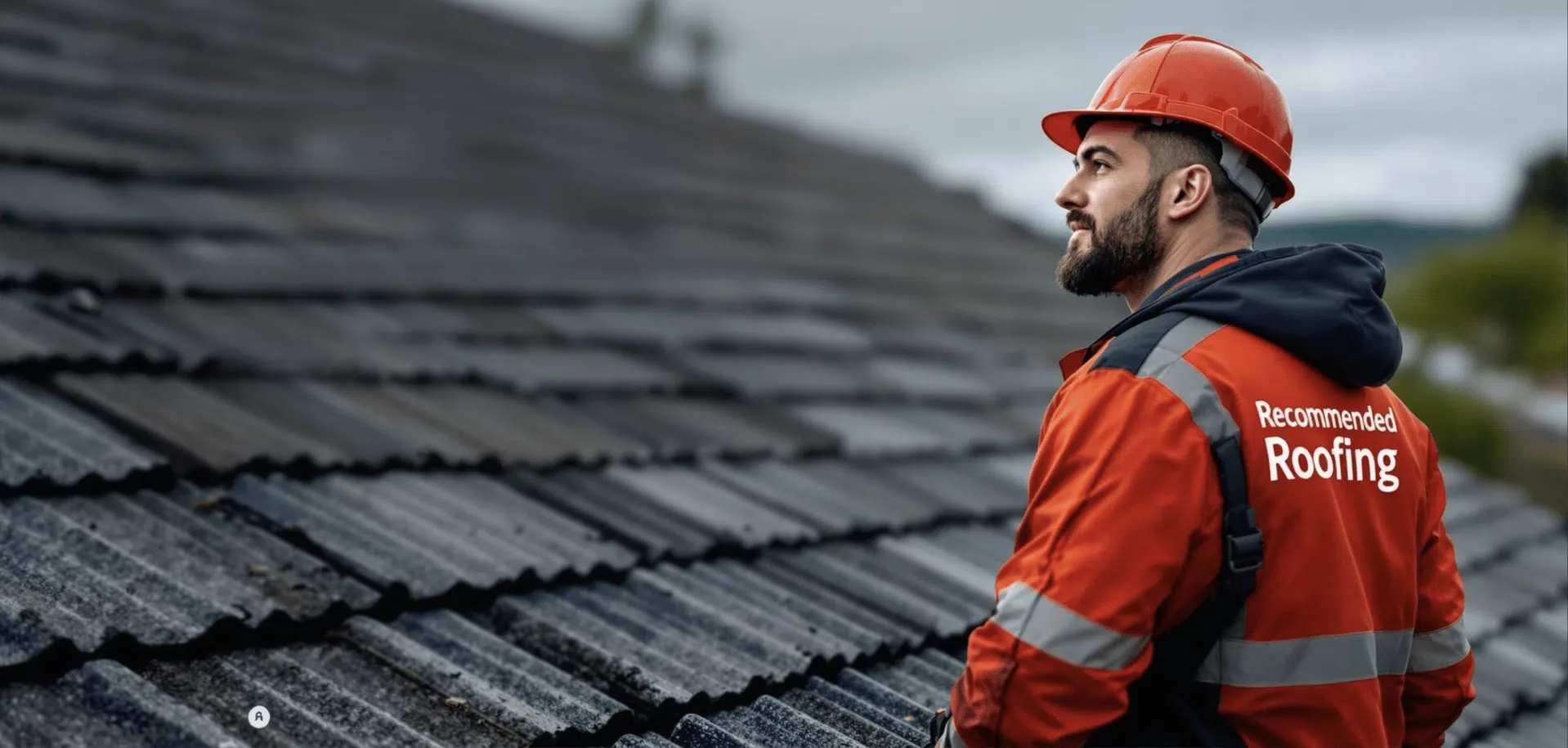

Fingal coastal estates, wind-lifted ridges and insurance callouts across Malahide, Portmarnock and Donabate
Roof repair in Swords typically costs between €400 and €2,500, with storm damage callouts running €1,500–€8,000 depending on access and scaffolding. On the 1990s and 2000s concrete-tile estates right across Fingal, the recurring faults are wind-lifted ridges, corroded sea-air fixings and failed verge mortar. Recommended Roofing covers Swords, Malahide, Portmarnock and Donabate with directly employed crews and a written guarantee from a minimum of 3 years up to 10 on major repair work.
Swords sits in a specific sweet spot of Irish housing stock. The town roughly tripled in size between the mid-1990s and the late 2000s, and most of what went up — Rivervalley, Boroimhe, Applewood, Holywell, Castleview, Thornleigh — was concrete interlocking tile on softwood battens, mortar-bedded ridges, and galvanised fixings. That was standard spec at the time and perfectly sound. Twenty to thirty years in, three things have caught up with those roofs at once.
The ridges have moved. Mortar bedding has a working life of roughly 20–25 years in a sheltered site and less than that on anything facing the Irish Sea. Once a hairline crack opens along the ridge, wind driven in off the Broadmeadow Estuary gets underneath, and the next south-westerly lifts the whole run. We see this constantly on north- and east-facing elevations in Rivervalley, and on the exposed terraces backing onto the coast road at Portmarnock.
The fixings have corroded. Salt-laden air from the estuary and the strand carries miles inland on a Fingal easterly. Standard electro-galvanised nails and clips don't survive it — the zinc coating goes, the steel underneath pits, and tiles start chattering in the wind long before they visibly slip. By the time a homeowner notices, half the perimeter course can be fixed on nothing but gravity.
The verge mortar has failed. The gable-end bed on a concrete-tile roof takes the full brunt of weather. On the Donabate–Portrane peninsula and out at Malahide Point, verge failure is often the first thing we're called to — a bulge, a drop, water tracking down the inside of the gable wall.
| Job | Indicative range |
|---|---|
| Slipped or broken tile replacement | €400 – €900 |
| Ridge re-bedding and re-pointing (full run) | €800 – €2,200 |
| Verge mortar replacement, gable end | €500 – €1,500 |
| Chimney flashing renewal | €700 – €1,800 |
| Storm damage callout (make-safe plus repair) | €1,500 – €8,000 |
| Emergency tile securing (temporary) | €200 – €500 |
These are indicative current Irish-market figures — exact rates are confirmed in writing after a survey, and VAT at 13.5% applies on top. The two things that move a Swords quote more than anything else are access (a corner site in Applewood with cherry-picker reach is very different to a mid-terrace in Boroimhe) and what we find under the first course of tiles once we're up there.
For a ballpark on a bigger scope of work, the roofing cost calculator will give you a sensible starting figure before anyone comes out.
Storm damage is the busiest category of work we do in north Dublin between October and March. Named storms tracking in off the Atlantic hit the north Fingal coastline before anywhere else in Dublin, and the pattern is predictable: ridges go first, verges go second, flashings go third, and anything already compromised goes in the same gust.
If water is coming in now, call us and we'll be on site within four hours to make the roof safe. That first visit stops the damage spreading. The permanent repair is quoted separately once it's safe to assess properly in daylight — this is the single biggest misunderstanding on emergency work, and we'd rather say it up front than have you expect a finished job out of a tarpaulin visit.
For the claim itself, your insurer will want a written assessment and dated photographs showing the cause and extent of damage. We produce both as standard on storm callouts, in the format loss assessors recognise. Full detail on how we handle insurance roof repairs — including dealing with the loss adjuster and sequencing the make-safe before the permanent works — is on the main repairs page.
A practical note on excesses: most Irish home policies carry a €250–€500 standard excess, with storm excesses sometimes higher. If the quoted repair is close to the excess, it's often not worth claiming — we'll tell you that honestly rather than push the paperwork.
This catches people out, so it's worth being plain about it. A like-for-like reroof — same material, same profile, same colour range — is normally exempted development under the planning regulations and doesn't need permission from Fingal County Council.
The moment any of the following enters the scope, you're likely into a planning application:
The practical sequence we recommend: get your reroof quote first, then take it to a Fingal planning agent or architect if any of the above apply, then come back to us to schedule the work around whatever consents are needed. We'll flag the planning question at the survey — obtaining the consent itself is the homeowner's job, and we won't start works that require permission without seeing it.
Our survey goes into the attic, not just around the eaves with binoculars. External-only inspections miss where water has already travelled — the staining on the back of the ridge board, the daylight through the valley, the fixings that have let go but haven't dropped a tile yet. You get a written, itemised, fixed-price quote. The price quoted is the price paid.
Our crews are directly employed — not subcontracted to whoever happened to be available that week. That matters on repeat callbacks and it matters for the guarantee, because the people honouring the work are the same people who did it. We carry €6.5 million public liability and €13 million employer liability insurance, we're registered with the Construction Industry Register Ireland, and we're a member of the National Guild of Master Craftsmen — all three verifiable before you appoint anyone.
For sea-exposed Fingal addresses we specify A4 stainless or silicon-bronze fixings as standard, not the galvanised equivalents that failed on the roof we're repairing. On ridge re-bedding we use a flexible modern bedding compound rather than straight sand-cement — it moves with the roof instead of cracking off it. On verge work, dry-fix systems are often a better long-term answer than fresh mortar on an exposed gable.
Honest answer, and this is the single most common question we get: repair if the covering is fundamentally sound and the problem is localised. Replace if repairs are becoming annual, if the battens and felt have gone (we can see that from the attic), or if the concrete tiles themselves are delaminating — a 1998 roof is at the 25–30 year mark and some tile batches from that era have not aged well.
We'll recommend a repair on a roof we could have sold you a replacement for. That's the whole point of going into the attic and writing it down.
If a reroof is the right answer, the full replacement carries a 10-year workmanship guarantee plus the Lifetime Leak Guarantee — a cover no competitor page in Dublin currently matches. The repair work discussed above carries the written workmanship guarantee of a minimum of 3 years, up to 10 years on major repairs.
The same crews cover the full Fingal coastal belt: Malahide, Portmarnock, Donabate, Rush, Lusk, Skerries and Balbriggan. Work we've completed around the county is on the roofing project gallery. For homeowners further south of the river, our roofers in South Dublin page covers Dundrum through to Dún Laoghaire, and the broader residential roofing service page sets out the full scope across Dublin.
If you're in Swords, Malahide, Portmarnock or anywhere across Fingal and you want a free, no-obligation written quote, get in touch for a Swords roof survey or call 01 2657795 and we'll arrange a visit.
How quickly can you get to an emergency in Swords? 24/7, on site within four hours anywhere in Fingal — Swords, Malahide, Portmarnock, Donabate, Balbriggan. The call-out is a make-safe to stop the water; the permanent repair is quoted separately once it's safe to assess.
Do you deal with the insurer directly? We produce the written assessment and photographic report your insurer or loss adjuster will ask for, in a format they recognise. The claim itself stays between you and your insurer, but we give you everything you need to run it.
Why do fixings fail faster on Fingal coastal estates? Salt-laden air carried in off the estuary and the Irish Sea accelerates corrosion on standard galvanised nails and clips. On exposed addresses in Portmarnock, Donabate and east-facing Malahide, we specify A4 stainless or silicon-bronze fixings so the repair lasts the full guarantee period.
Do I need planning permission to reroof my Swords house? Like-for-like reroofs are normally exempted development. Change of material, change of profile, dormer additions, protected structures and ACA properties in Malahide typically do need Fingal County Council consent — we flag it at survey.
How long does a ridge re-bed take on a three-bed semi in Rivervalley or Boroimhe? A full ridge run on a standard three-bed semi is typically a one-day job in dry weather, two if the weather turns or if verge and chimney flashing work goes on alongside it.
What guarantee do I get on a Swords repair? A written workmanship guarantee of a minimum of 3 years, up to 10 years on major repair work. A full re-roof carries the automatic 10-year guarantee plus our Lifetime Leak Guarantee, handed over in writing before contracts are signed.
Are you insured and registered? €6.5 million public liability, €13 million employer liability, CIRI registered, Guaranteed Irish, and a member of the National Guild of Master Craftsmen. We'll show you the certificates before you appoint us — a contractor who doesn't want to be checked is telling you something.
Roof Repairs in Ireland. Free survey, written fixed-price quote, 10-year guarantee.