Roof Replacement Cork: 2026 Costs and What's Involved
A full roof replacement in Cork typically costs €8,500 to €22,000 for a 3-bed semi in 2026. Here is what it involves, how long it takes and how to decide between a repair and a new roof.
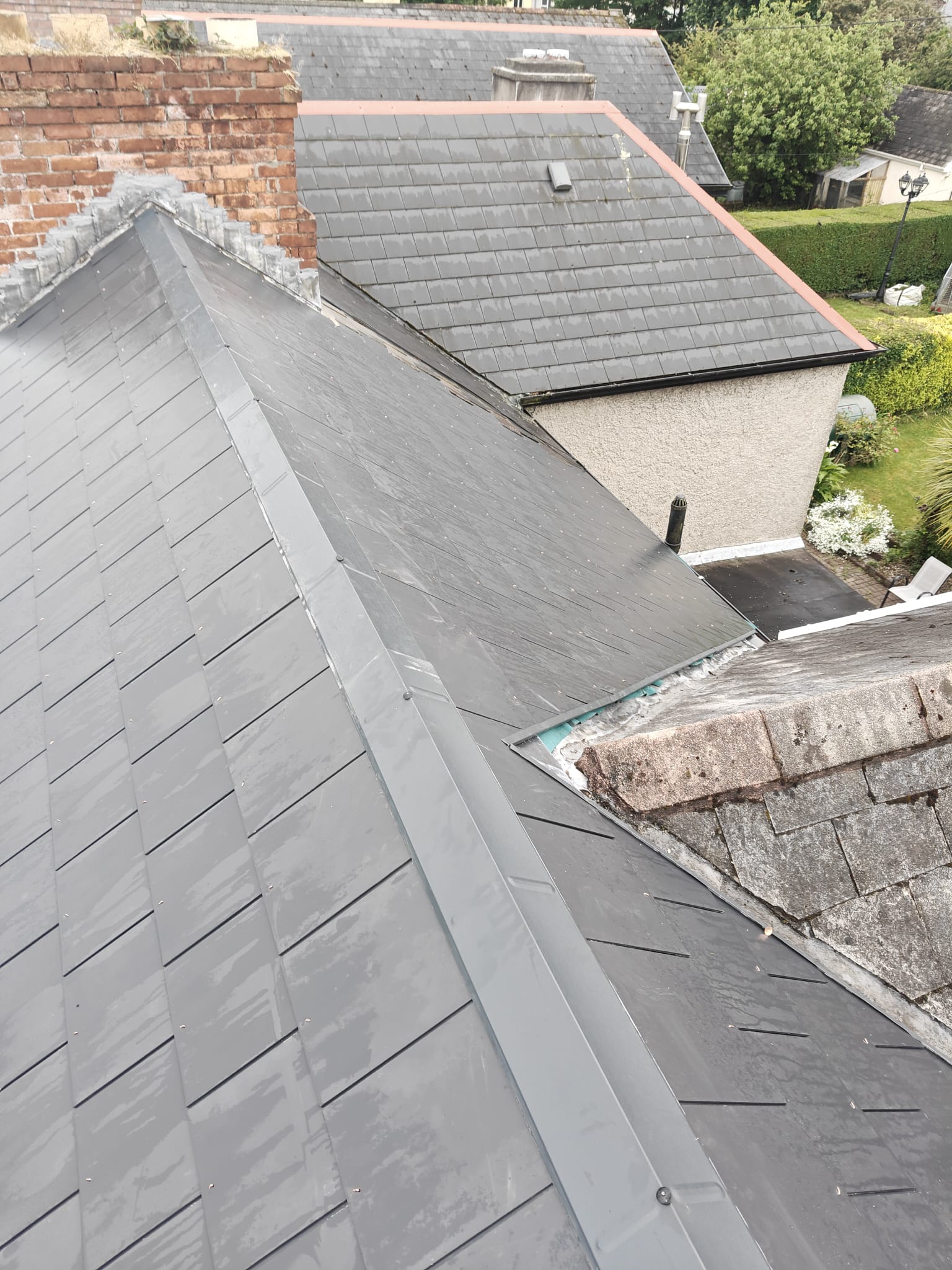

A full roof replacement in Cork typically costs €8,500 to €22,000 for a 3-bed semi in 2026. Here is what it involves, how long it takes and how to decide between a repair and a new roof.
This guide is for Cork homeowners deciding whether to repair or replace. For national prices, see our roof replacement cost guide for Ireland. For a straight price breakdown by roof type in Cork, see new roof cost in Cork.
Cork is one of the wetter parts of the country, with roughly 1,200mm of rain a year at the airport. Add Atlantic wind and salt air on the coast, and roofs here work harder than most.
In Cobh, Kinsale and Crosshaven the salt eats fixings and flashings. In Ballincollig, Douglas, Bishopstown and Carrigaline, most estates date from the 1970s to the 1990s and carry concrete tiles that are now 30 to 50 years old. Older city streets around Blackrock, Montenotte and Sunday's Well often have natural slate on the original iron nails.
Hilly sites matter too. Steep streets and tight access change how we scaffold and where the skip goes, and that shows up in the price.
Most Cork homeowners ringing about a leak need a roof repair in Cork, not a new roof. We say so on the survey if that is the case. A re-roof makes sense when you see several of these together:
Three or more of those usually means a re-roof costs less over ten years than chasing leaks every winter. Our Cork roof repair cost guide shows what repairs run so you can compare.
These are indicative Irish-market prices for a typical 3-bed semi in Cork. Pitch, access, chimney count and the condition of the timber underneath all move the number, so treat them as a guide until you have a survey.
Indicative 2026 price range, supply and fit, in euro
Every price includes scaffold, strip-out, skip hire and licensed disposal, breathable underlay, treated battens and lead flashings. Extra rotten timber is priced separately, and we tell you before we touch it.
The covering you pick sets the price, the lifespan and how the roof copes with Cork weather. Here is how each option compares on a typical semi.
| Material | Typical lifespan | Indicative re-roof price | Best suited to |
|---|---|---|---|
| Concrete tile | 40 to 50 years | €8,500 to €13,500 | Estates from the 1970s to the 2000s, tight budgets |
| Fibre cement slate | 50 to 60 years | €11,000 to €16,000 | Houses that want a slate look without natural slate cost |
| Natural slate | 80 years or more | €15,000 to €22,000 | Older city homes, Victorian terraces, long-term owners |
| EPDM flat roof | 25 to 30 years | €80 to €120 per m² | Extensions, dormer cheeks, garages |
Concrete interlocking tile is what most Cork estates are built with, including large parts of Ballincollig, Douglas, Bishopstown and Carrigaline. It is the cheapest covering to replace like for like and it is heavy, so it stays put in a gale when it is fixed to standard. The factory coating wears off from around year 30, after which the tile soaks up rain, freezes and flakes on the surface.
If your roof is concrete and showing green algae and surface flaking, it is usually worth a full re-roof rather than patching. New tiles come with modern dry-fix ridge and verge, which removes the cracked mortar that causes most leaks on older estates.
Made from cement and reinforcing fibres, rolled thin to look like natural slate. It is lighter than concrete tile, so it puts less load on older roof timbers, and it is a common upgrade on 1960s to 1980s houses where the owner wants a slate look at a middle price. Brands such as Cedral publish their technical data online if you want to compare products.
It is not as long-lived as natural slate and it needs careful fixing, because fibre cement slate is more brittle underfoot. That is one reason to use a roofer who works on slate every week.
Natural slate is the premium covering and the right match for many older Cork city homes around Blackrock, Montenotte and Sunday's Well. A good slate roof outlasts everything else here. The slate itself is rarely what fails. The iron nails rust through after 80 to 100 years, which is called nail sickness, and slates start to slip with no obvious storm cause.
When that happens the slates are often still perfect. A re-roof can strip, sort and refix the good ones with stainless or copper nails, which cuts the bill compared with all new slate. Spanish slate is the usual choice for new work. Welsh and Killaloe slate suit heritage and protected buildings, and are priced on survey.
EPDM rubber is our default for flat roofs on extensions and dormers. It is laid as a single sheet with no seams to fail, and it handles Irish rain and UV well. Fibreglass (GRP) suits very small areas. We avoid felt on anything new. Our flat roofing page and flat roofing cost guide cover the options in more detail.
The tile or slate is only the top layer. Three other parts decide whether the roof lasts:
A new roof is also the cheapest time to fix attic ventilation and insulation. See attic insulation and roof ventilation in Cork, and our guide to SEAI retrofit grants for what may be covered.
For most Cork estates, concrete tile or fibre cement slate gives the best value. For older homes with original natural slate, re-roofing in slate keeps the character of the house and the street, and avoids planning trouble in sensitive areas. Our slate versus concrete tile guide goes deeper on the trade-offs, and the same points apply on the Cork coast. For a full list of roofing guides, see our roofing guides.
Useful outside sources: CIRI, the Construction Industry Register Ireland, to check any contractor is registered, and Met Éireann climate data for rainfall and wind in your area.
A 3-bed semi takes 4 to 7 working days in dry weather.
If a storm is forecast mid-job, the roof is covered and secured before we leave. It is never left open overnight.
Not sure who to trust? Read how to vet a roofer in Cork before you sign anything.
We replace roofs across four cities with local crews. If you are outside Cork, these guides cover your area:
Call our Cork office on 021 2040925 or use the contact form. A qualified roofer visits, checks the roof and the attic, and gives you a fixed price in writing. If a repair is the better call, we will say so. See all our roofing services in Cork.
We also wrote “Roof Replacement Cost in Cork: What €8K–€25K Actually Buys You” on our Blogger page.
A standard 3-bed semi takes 4 to 7 working days in dry weather. Larger detached homes and natural slate jobs can take 8 to 12 days. We schedule around the forecast and cover the roof every evening.
Not for a like-for-like re-roof, which is exempted development. You need permission to change the roof profile or add dormers, and a Protected Structure or conservation area needs a check with Cork City or County Council first.
Yes. We work in dry windows and never leave a roof open overnight. Work only stops in sustained heavy rain or high wind. Winter jobs often take a day or two longer.
Only if the damage is sudden and caused by something like a storm or a fallen tree. Age, wear and nail sickness are not covered. We give you a written report if you have a genuine storm-damage claim.
If less than about 15% of the roof is failing and the underlay is sound, repair it. If you have nail sickness across a whole slope, perished underlay or repeated leaks in different rooms, re-roof. We price both on the survey so you decide on real numbers.
Yes. Skip hire, strip-out and licensed disposal are in the price. Concrete tiles are recycled where possible, and good natural slate can often be reused or credited back to you.
Nearby areas we cover
New Roof Installation in Cork, Ireland. Free survey, written fixed-price quote, 10-year guarantee.