Dry Ridge and Dry Verge Systems for Cork Roofs
Why Wet-Bedded Mortar Ridges Blow Off in Exposed Ballycotton, Youghal and Ringaskiddy Homes
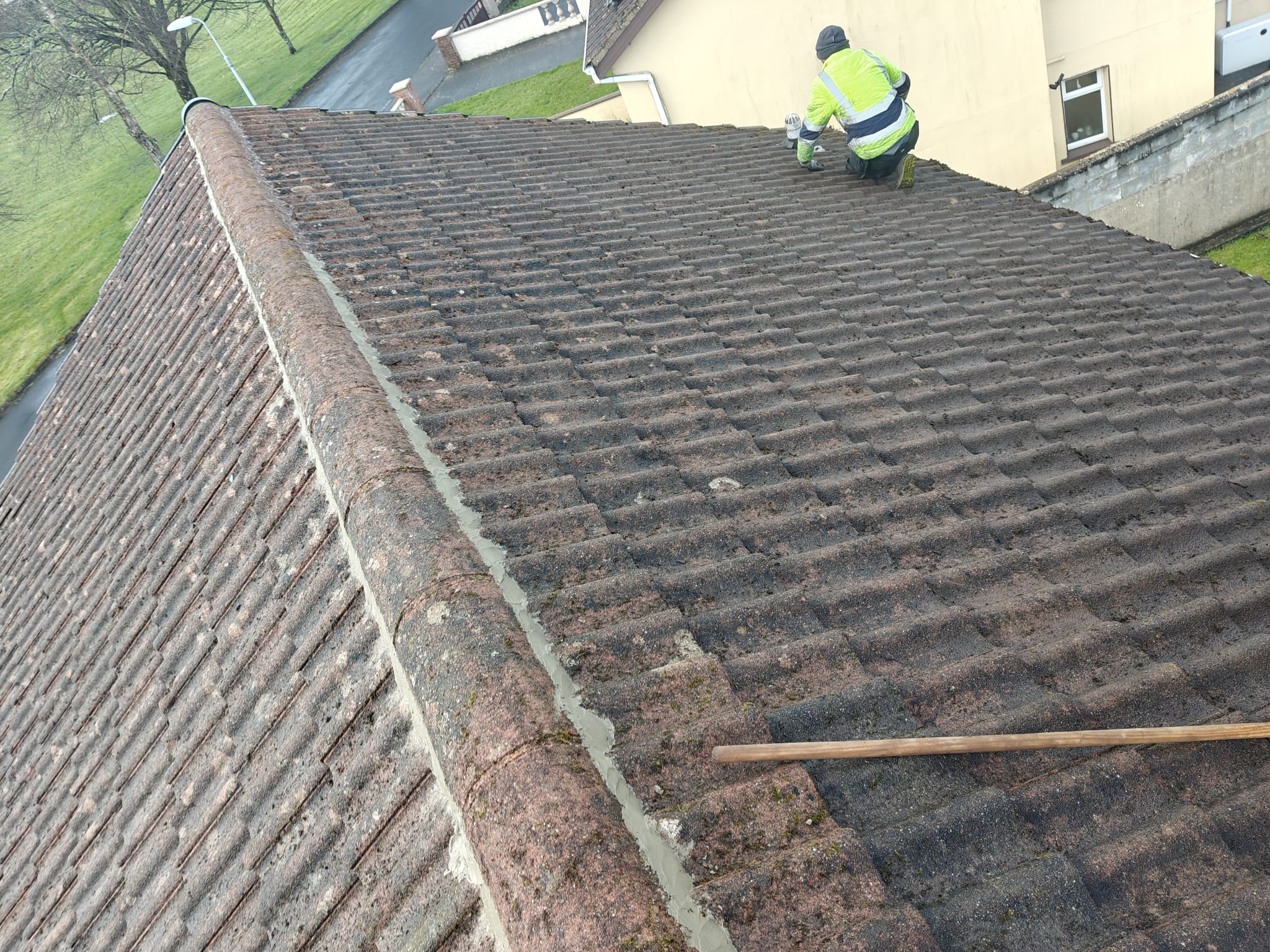

Why Wet-Bedded Mortar Ridges Blow Off in Exposed Ballycotton, Youghal and Ringaskiddy Homes
If ridge tiles keep lifting off your roof in Ballycotton, Youghal or Ringaskiddy, the fix is a mechanically fixed dry ridge system that clamps every tile to the ridge batten with stainless screws and a unions strap — replacing the sand-and-cement bedding that Atlantic wind uplift keeps cracking loose. It's the current I.S. EN 1304 expectation on Irish re-roofs, and on exposed east Cork coasts it's now the only sensible spec. Call 021 2040925 for a fixed-price quote.
That's the short answer. The longer one matters, because if you own a house within a couple of kilometres of the harbour and you're still nursing a mortar-bedded ridge, the next Storm Éowyn-style low will find it.
Cork's coastal strip — from Ballycotton lighthouse through Knockadoon, Youghal town, Whitegate and around into Ringaskiddy and Currabinny — sits inside what the Irish wind map treats as a Zone 4/5 exposure band. Gusts of 130–150 km/h aren't unusual in winter. The 2024/25 season alone saw three named storms push sustained speeds over 100 km/h across east Cork.
Sand-and-cement bedding was designed for a calmer world. It works like this:
Now add fifteen Irish winters. The mortar shrinks. Hairline cracks open. Water gets in, freezes, expands. Wind pressure below the ridge (uplift) pushes upward while pressure above pushes across. The bond fails at the interface between mortar and tile long before the mortar itself crumbles. On a windward-facing ridge in Ballycotton, we've pulled ridge caps off by hand after only 12 years.
The NHBC Standards (Chapter 7.2) and the Irish adoption of I.S. EN 1304 both now treat mortar-only bedding as inadequate on exposed sites. Every ridge and hip tile needs a mechanical fixing — a screw or clip that ties the tile back to the timber, independent of the mortar.
A dry ridge kit replaces the wet mortar with three components:
The system ventilates the ridge (roughly 5,000 mm² per linear metre of airflow), stops wind-driven rain being forced under the cap, and — critically — mechanically locks every single ridge tile to the structure. No cement. No annual re-pointing. No lifted caps after a January storm.
Dry verge does the same job at the gable end. Instead of mortar bedding along the barge, interlocking plastic or aluminium units clip over each tile edge and screw into the verge batten. On the exposed gable of a Youghal semi facing the Blackwater estuary, that's the difference between tiles staying put and finding them in the neighbour's garden.
I.S. EN 1304 is the European standard for clay and concrete roofing tiles, adopted in Ireland. It doesn't specify dry systems by name, but it references BS 5534:2014+A2:2018 — the code of practice for slating and tiling — which Irish roofers work to. BS 5534 is unambiguous:
That means when we re-roof a bungalow in Ringaskiddy, we're not choosing between mortar and dry ridge on aesthetics or price. The dry system is the compliant spec. Mortar-only is a defect on day one, and it will show up on any homebuyer's survey.
If you're weighing up a full re-roof, our residential roofing service across Ireland always quotes dry ridge and dry verge as standard on coastal jobs — it's not an upsell, it's the spec.
Not every Cork address needs the same fixing schedule. Here's how we grade the exposure on a site visit:
Ballycotton and Knockadoon Head — the worst of it. Cliff-top and headland houses catch clean, undisturbed Atlantic wind. We spec 6 screws per 3 m ridge, aluminium dry verge (not plastic — UV and salt eat plastic verges in 8–10 years here), and 200 mm underlay laps.
Youghal quayside, Ferry Point and Redbarn — estuarine funnel effect. The Blackwater channels wind up the strand. Standard dry ridge with 4 screws per 3 m, plus mechanically fixed eaves clips on the first two tile courses.
Ringaskiddy, Currabinny and Monkstown — harbour exposure plus industrial wind-shadow turbulence off the port cranes. Uplift is gusty rather than sustained. Dry ridge with 4 screws, but we pay extra attention to hip tile fixings because the turbulence hits corners hardest.
Compare that to a sheltered inland job — say, a re-roof in Blackpool on the north side of the city — where mortar bedding with mechanical fixings would still pass, though we'd rarely spec it now. Same story in Glanmire and Little Island; if you're inland of the N25, exposure drops fast.
These are indicative 2025 Irish-market ranges — confirm exact rates with a site visit.
| Job | Typical scope | Indicative price |
|---|---|---|
| Ridge-only retrofit (existing tiles OK) | Strip mortar, fit dry ridge kit to ~10 m apex | €850 – €1,400 |
| Ridge + hip retrofit | Semi-detached with two hips | €1,600 – €2,400 |
| Full dry ridge + dry verge | Detached, ~14 m ridge + 2 gables | €2,200 – €3,400 |
| Full re-roof with dry systems included | Standard 3-bed detached | €14,000 – €22,000 |
Prices vary with scaffold requirements, tile compatibility (some older Redland profiles need adaptor kits), and whether the ridge batten needs replacing. On coastal jobs we almost always renew the ridge batten — 40+ year old timber under a leaky mortar bed is usually softened.
You can get a rough starting figure with our roofing cost calculator before ringing us.
Two honest caveats. First, hybrid systems — mortar bedding plus mechanical fixings — are still permitted under BS 5534 and are common on heritage properties where the aesthetic of a pointed mortar joint matters. Youghal's protected structures often need this compromise. The mortar is decorative; the screw does the work.
Second, very sheltered inland sites (dense suburbs, valley locations, surrounded by mature trees) can still get long life out of well-pointed mortar with mechanical fixings. If your Wilton or Bishopstown semi has never had a ridge issue in 30 years, you don't need to panic.
But if you're within about 3 km of the coast, or you can see the sea from an upstairs window, the calculation is different. The wind loading data doesn't care what your grandfather's roofer did in 1978.
A typical 3-bed semi in Youghal takes a two-man crew a day and a half, plus scaffold up and down. Our gallery of completed roofing work has before-and-afters from east Cork jobs if you want to see the finish.
If you're in Ballycotton, Youghal, Ringaskiddy, or anywhere along the east Cork coast and you're watching your ridge tiles rattle every time the wind gets up, don't wait for the next amber warning. A dry ridge retrofit is a one-day job that ends the problem permanently.
We cover the full harbour belt from the city out — including roofing work in Glanmire and Little Island — and we quote coastal jobs to the current I.S. EN 1304 spec by default. No upselling; that's just the standard now.
Call 021 2040925 or request a fixed-price quote through our contact page — we'll come out, look at the ridge, check the batten, and price the retrofit properly.
The mechanical components — stainless screws, aluminium verge units, butyl union strap — are rated for a 40+ year service life in Irish coastal conditions. That matches or exceeds the tiles themselves. Plastic dry verge components have a shorter life (15–20 years in salt-laden air), which is why we spec aluminium in Ballycotton and Ringaskiddy.
Yes. A ridge-only retrofit takes a day, doesn't disturb the main tile field, and typically costs €850–€1,400 indicatively for a standard semi. It's the single best-value storm-proofing job on a coastal Irish home. Rates should be confirmed on site.
Yes — it's the compliant option under I.S. EN 1304 and BS 5534:2014+A2:2018, which Irish roofers work to. Wet-bedded mortar without mechanical fixings does not comply on exposed sites and will typically be flagged on a homebuyer's structural survey.
A correctly installed dry ridge is more weathertight than mortar. The butyl-backed union strap provides a continuous seal that mortar joints can't match once they crack. The only leaks we've seen on dry ridge installs have been from union strap laps that weren't sealed properly — an install fault, not a system fault.
Not directly — SEAI grants cover insulation and energy upgrades, not ridge and verge work. However, if you're doing a full re-roof with attic insulation upgrade at the same time, the insulation element may qualify under the One Stop Shop or Better Energy Homes schemes. Ask your grant contractor.
Yes, in almost all cases. Working on a ridge means working at the highest point of the roof — HSA rules and basic sense require edge protection. A tower scaffold or ridge-access scaffold typically adds €400–€800 to a standalone ridge job. It's included in our fixed-price quote.
Nearby areas we cover
Roof Repairs in Cork, Ireland. Free survey, written fixed-price quote, 10-year guarantee.