New Roofs in Cork
Costs, Timelines and the Lifetime Leak Guarantee on Full Replacements

Costs, Timelines and the Lifetime Leak Guarantee on Full Replacements
Not every leaking roof needs replacing. A slipped ridge, a cracked slate above the valley, a bit of failed pointing on the chimney, those are repairs. What tips a Cork house into "new roof" territory is usually one of four things.
Nail sickness. On slate roofs put down before the mid-1970s, plenty of them across Sunday's Well, Montenotte and the older parts of Douglas, the iron nails holding the slates rust through. Slates start sliding off in twos and threes after every storm. Once nail sickness is widespread across the whole slope, patching is throwing good money after bad.
Sagging or spongy timbers. If the ridge line dips when you look up from the road, or the felt is torn and the rafter ends are wet, the deck is going. Common on 1930s to 1960s houses in Ballyphehane, Turners Cross and Blackpool where the original felt has finally given up.
Concrete tiles past their date. Marley and Redland concrete tiles from the 1970s and 1980s, the standard fit on estates in Bishopstown, Wilton and Glanmire, start delaminating around the 40 to 50 year mark. You will see the surface flaking, moss holding water, and hairline cracks running with the frost.
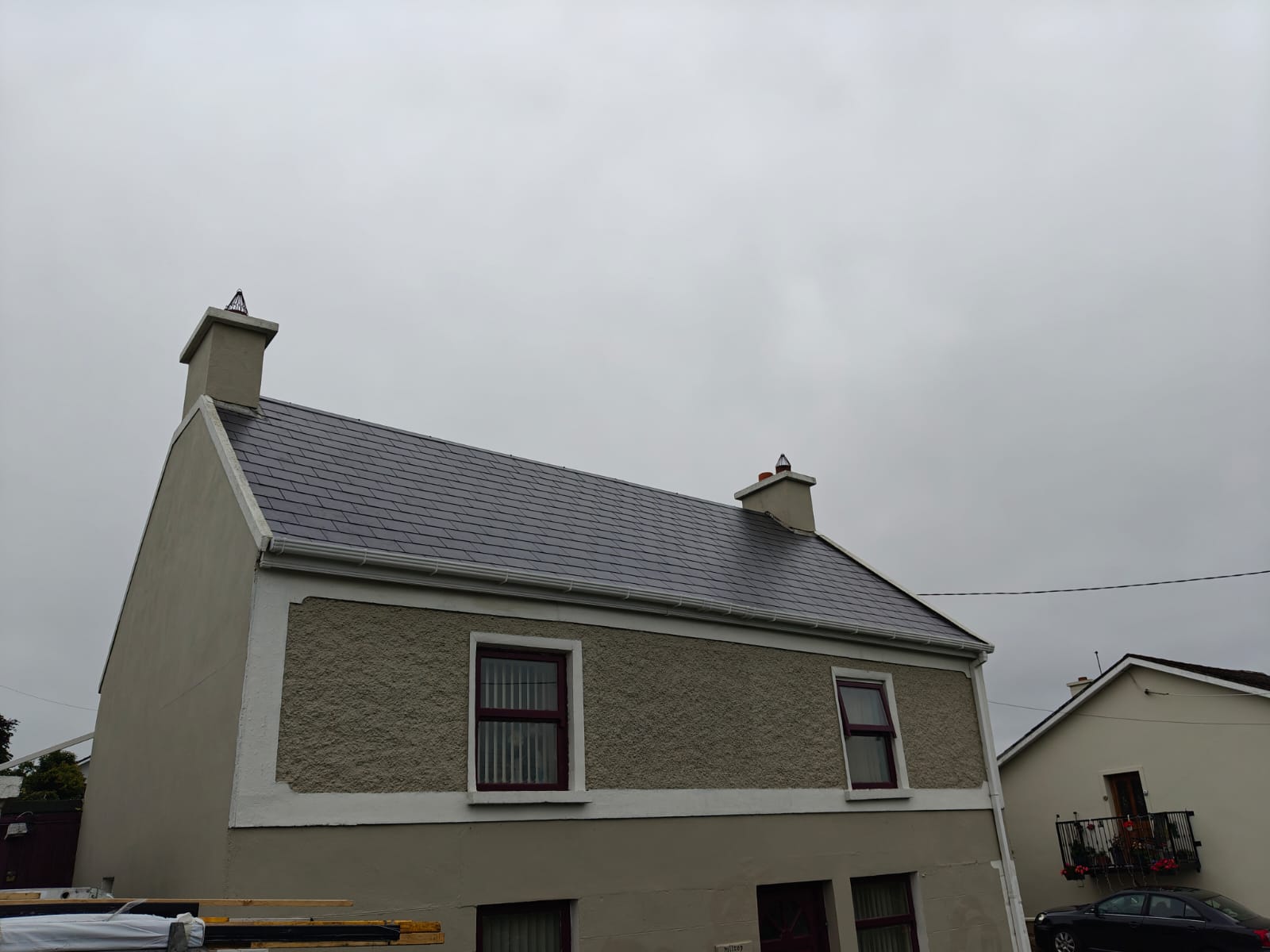
Multiple leaks in different places. One leak is a repair. Three leaks in three different spots inside twelve months means the roof as a system has failed. As the Blanchardstown slate replacement shows clearly, when the underlay and battens have gone across the whole roof, repair stops being the cheaper option and becomes the more expensive one paid in instalments.
If you are not sure which camp you are in, we will come out and tell you straight. A repair is usually a repair. A new roof is a serious spend and we will not push one on you that is not needed. See our roof repair service for guidance on what repair work covers, or our roof replacement guide for Cork for a fuller look at the replacement decision.
The ranges below are indicative 2026 figures. Every house is different and the only way to get a firm number is a free survey and written quote.
Indicative 2026 price range in euro, excluding VAT at 13.5%
| Covering | Indicative 2026 range | Typical timeline |
|---|---|---|
| Concrete tile | €8,000, €18,000 | 4-10 days |
| Natural or fibre-cement slate | €12,000, €28,000 | 5-14 days |
What moves a quote up or down: pitch (anything under 22.5 degrees needs interlocking tile; over 45 degrees needs extra fixings), access (terraced houses in Blackrock village take longer to scaffold than a detached house in Rochestown), the state of the timbers once we strip it, chimney count, whether valleys and hips add complexity, and whether the guttering is renewed at the same time. On jobs of €10,000 or more, we ask for a 33% deposit up front and the balance on completion. Below that, payment is on completion.
For a detailed breakdown of what shifts the price, see our new roof cost guide for Cork. Our full price guide covers all services.
A cheap quote usually means something is being left out. Here is what a full re-roof on a Cork house should include, and what we include as standard.
For the technical detail on underlays, battens and dry-ridge systems, see our guides on roof battens in Cork and dry-ridge and dry-verge systems for Cork roofs.
The traditional choice for period and conservation-area properties across Sunday's Well, Shandon and the older parts of Douglas. A properly installed natural slate roof will last 80 to 100 years. It costs more upfront than tile, but on a terrace where the roofline needs to stay consistent, or on a protected structure, it is often the only appropriate option. We source matching natural or reclaimed Welsh slate for period terraces where blending matters.
Lighter than natural slate, rated at 50 to 60 years, and available in a range of profiles that suit both period and modern homes. A practical middle ground where natural slate is not specified but concrete tile is not appropriate.
The volume choice on estates from the 1970s onwards, Bishopstown, Wilton, Glanmire. It is the more affordable option, has a lifespan of 40 to 50 years, and there is a wide range of profiles and colours. The main risk is delamination and frost damage once tiles pass the 40-year mark, which is why so many Cork estates are reaching replacement age now.
The covering is the visible part. The breathable felt underlay, the treated battens gauged to spec, and the ridge and eaves ventilation are what determine whether the roof performs over its full life. A roof stripped and re-covered on failed felt and rotten battens is a roof that will fail again. We replace all of these as standard on a full re-roof. See our article on attic insulation and roof ventilation in Cork for more on getting the ventilation right at the same time.
Every full roof replacement Recommended Roofing installs in Cork carries a 10-year written workmanship guarantee and a Lifetime Leak Guarantee. If the roof leaks because of anything we installed, the felt, the battens, the slates, the flashings, the ridge, we come back and fix it at no cost, for as long as you own the property.
Repairs and partial jobs carry a written guarantee of a minimum of 3 years, up to 10 years on major repair work. That is still longer than most competitors offer, but it is not the Lifetime Leak Guarantee, which applies only where we have controlled the whole system on a full replacement.
The guarantee is handed over in writing before contracts are signed, not promised afterwards. We employ our crews directly, the people on your roof are our own people, not subcontractors. You can read what Cork customers say on our reviews page. CIRI registration, insurance certificates and our VAT number (IE04393055LH) are all verifiable and we actively encourage you to check them before appointing us.
“For our Sunday's Well home I needed a last-minute replacement of leaking roof at the rear of a three-storey house. Recommended Roofing provided a prompt, fair estimate and — despite the wet weather — had a scaffold tower in place and the job finished in one day. The installers (David and one colleague) were efficient, courteous, and helpful throughout, and they left the site tidy, removing all waste. Very pleased with the quick response, the team, and the quality of the work. Highly recommended.”Andy Byrne, Sunday's Well, Cork, ★★★★★ on Google
For a standard semi, weather permitting:
Cork weather being what it is, we build a contingency into every job. We will not strip a roof if there is heavy rain forecast that we cannot get sheeted before dark. Coastal spots, Youghal, Kinsale, Cobh, need closer attention to wind than to rain. Dormers, valleys and hips add one to two days on a more complex roof.
For a like-for-like re-roof on an existing house, planning permission is not required under Class 1 exempted development. If you are changing the profile, raising the ridge, adding dormers or rooflights that alter the streetscape, or working on a protected structure, that is different, check with Cork City Council or Cork County Council planning before you commit.
Protected structures, many in the city centre, Shandon and parts of Blackrock, need extra care. Natural slate, lime torching where original, and lead not zinc are the right specification. We have worked on period properties across Cork and know what conservation officers expect.
SEAI grants do not cover the roof covering itself, but if the attic insulation is thin, doing it while the scaffold is up is the cheapest time you will ever have to carry out that work. The SEAI grants page sets out what is available. Our guide on SEAI retrofit grants for 2026 explains how these interact with roofing work.
We install new roofs across Cork city and county: from Blackpool and Mayfield in the north, south to Douglas, Rochestown and Carrigaline, west to Ballincollig and Wilton, and east to Glanmire, Little Island and Midleton. County towns including Mallow, Cobh, Midleton, Bandon, Fermoy, Kinsale and Clonakilty are all within our area.
Our gallery of completed roofing projects has photographs of Cork jobs, slate, tile, dormer and full cut-roof work. Filmed jobs are on our videos page so you can see the standard of work from strip to finish.
If you are comparing costs or researching on behalf of a property elsewhere, we cover three other cities. Each has its own detailed cost guide:
To arrange a free survey and written quote, call us on 021 2040925 or use our Cork contact page. We will come out, measure up, check the timbers and the chimney, and give you a fixed-price quote in writing, no provisional sums, no surprises mid-job.
Indicative 2026 ranges are €8,000 to €18,000 for a concrete tile roof and €12,000 to €28,000 for a natural or fibre-cement slate roof. VAT at 13.5% applies on top. The exact figure depends on roof area, pitch, access, chimney count, timber condition and material choice. We give a free written fixed-price quote after a survey.
A standard three-bed semi takes 3 to 7 working days in dry weather. Dormers, valleys and hips add one to two days. Scaffold typically goes up on day one and comes down on the final day.
Every full roof replacement carries a 10-year written workmanship guarantee and a Lifetime Leak Guarantee. If the roof leaks because of anything we installed, we come back and fix it at no cost for as long as you own the property. The guarantee is given in writing before contracts are signed.
No. VAT at 13.5% applies on top of all roof replacement prices. Our written quotes show the VAT separately so there is no ambiguity.
No, not for a like-for-like replacement on an existing house. It is Class 1 exempted development. You do need permission if you are changing the shape, raising the ridge, adding dormers or rooflights that alter the streetscape, or if the house is a protected structure.
SEAI grants do not cover the roof covering itself. However, attic insulation upgrades are grant-eligible and the cheapest time to do them is while the scaffold is already up. The SEAI grants page at seai.ie/grants sets out what is available.
Scaffolding is itemised separately, never buried in the job price. Most full re-roofs do require scaffold. It appears as a separate line on the written quote, and if you can source suitable scaffolding yourself at a better rate, you are welcome to do so.
A re-roof strips everything back to the rafters, old covering, felt and battens, and starts again with new materials. An overlay puts new tiles over the old ones. We do not do overlays. They add weight the rafters were not sized for, they hide problems, and they are not eligible for the Lifetime Leak Guarantee.
A slipped slate, a failed valley or a cracked ridge are usually repairs. Widespread nail sickness, spongy timbers, delaminating concrete tiles across the whole slope, or multiple leaks in different locations in the same year are signs a replacement is more economical. We come out and tell you straight, we will not recommend a replacement if a repair will do the job.
Yes, where possible. On period terraces in Sunday's Well, Turners Cross or Blackrock we source matching natural or reclaimed Welsh slate so the roofline stays consistent. It costs a little more and takes a little longer but it is the right call on a terrace.
Yes. We re-roof year-round. We work in tighter weather windows from November to February and sheet the roof overnight if it is not fully covered. Winter jobs sometimes take a day or two longer but the standard of finish is the same.
Call 021 2040925 or book a free survey through our contact page. We come out, measure up, check the timbers and the chimney, and give you a written fixed-price quote. No provisional sums, no surprises mid-job, and no obligation.
Nearby areas we cover
Roof Repairs in Cork, Ireland. Free survey, written fixed-price quote, 10-year guarantee.