New Roof Installation in Drumcondra and Glasnevin
Full Re-Roof Costs and Process on 1930s and 1940s Corporation Semis
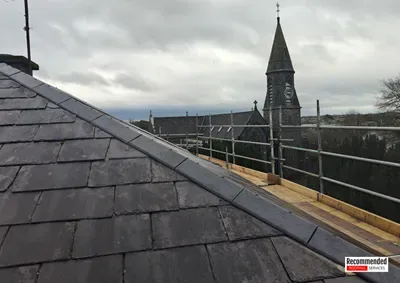

Full Re-Roof Costs and Process on 1930s and 1940s Corporation Semis
A full re-roof on a typical 1930s or 1940s Corporation semi in Drumcondra or Glasnevin costs between €11,000 and €18,000 in 2025, depending on slate choice, chimney and party-wall work, and scaffold access on narrow streets. Expect 5–8 working days on site, a Dublin City Council skip permit, and full stripping of the original Bangor Blue slate down to the purlin structure. For a fixed-price quote, call 01 2657795 or request a survey through our new roof installation team.
That's the short answer. Below is the detail — what you're actually dealing with on Ferguson Road, Hollybank, Botanic Avenue, Iona, Home Farm and the streets around Griffith Avenue — and what a proper re-roof on this housing stock should look like in 2025.
The Dublin Corporation semis built between 1932 and 1948 across Drumcondra, Glasnevin, Whitehall and Marino were roofed almost exclusively in Bangor Blue slate from North Wales, fixed with iron nails onto sawn softwood battens over rough-sawn purlins. The slate itself is superb — Bangor Blue routinely lasts 100–120 years — but the iron nails don't. They corrode, snap, and slates start slipping. Roofers call this nail sickness, and on a roof laid in 1938 you're now 85+ years in.
Common failure points we see weekly on North Dublin surveys:
If you've had two or more patch repairs in the last three years, or the ceiling in the back bedroom is staining after every south-westerly, a full re-roof is almost always cheaper over ten years than continued patching.
Here's the process we follow on a standard 3-bed semi off Drumcondra Road Lower or Botanic Road:
You get a written 20-year workmanship guarantee and manufacturer warranties on slate (30 years) and membrane (15 years).
The following are indicative current Irish-market ranges for a standard 3-bed semi with roof area around 75–95 m² including the rear return. Call 01 2657795 to confirm exact rates for your property.
| Element | Indicative cost (incl. VAT) |
|---|---|
| Full strip and re-slate with fibre-cement (Cembrit) | €11,000 – €13,500 |
| Full strip and re-slate with new Spanish natural slate | €13,500 – €16,500 |
| Full strip and re-slate with reclaimed Bangor Blue | €15,500 – €18,500 |
| Party-wall chimney rebuild above roof line | €1,400 – €2,200 extra |
| New fascia, soffit and aluminium gutters | €1,800 – €2,800 |
| Scaffold (typical 6–8 day hire, front and rear) | €1,200 – €1,800 (usually included) |
| Dublin City Council skip permit | €40 per skip, per week |
Rear return roofs, dormer cheeks and bay windows add cost. So do velux upgrades — a good time to add one is during the re-roof, not after.
If you want a rough figure before ringing, try the roofing cost calculator for a ballpark, then we'll firm it up on the survey.
Homeowners on streets like Iona Road and Lindsay Road often want to keep the Bangor Blue look — and rightly so, it's part of the character. You have three sensible options:
On a mid-terrace or semi, there's also a planning courtesy to consider: if your neighbour has original Bangor Blue and you switch to fibre-cement, the terrace looks patchy. Not a legal issue outside an ACA, but worth a chat over the wall.
Nearly every Corpo semi in Drumcondra and Glasnevin has a shared chimney stack straddling the party wall. Two flues yours, two your neighbour's. When we re-roof, we have to:
If the stack is leaning or the brick above roof level is spalled, we'll price a partial rebuild — usually €1,400–€2,200. It's cheaper to do it now with scaffold up than to come back in three years.
This is where local knowledge earns its keep. Streets like Ferguson Road, St. Patrick's Road, Enniskerry Road and Millmount Avenue are narrow, with cars parked both sides and no off-street parking on the front. Practical realities:
We handle all permits, insurance certs, and neighbour notifications as part of the fixed-price quote. You don't chase the Council — we do.
While the slates are off is the only sensible time to upgrade eaves ventilation and add over-rafter insulation if you're planning an attic conversion later. SEAI grants for attic insulation (currently €1,300 for a semi-detached under the Better Energy Homes Scheme) can be claimed separately — we can't do the insulation grant work directly, but we'll co-ordinate with your insulation contractor so the sequencing works.
Cross-ventilation via eaves vents and a breathable membrane is now standard — the old "no felt" 1940s roofs actually breathed better than a badly-detailed modern one. We build in ventilation properly so you don't get condensation in the attic five years later.
We've re-roofed dozens of Corpo semis across North Dublin — Drumcondra, Glasnevin, Marino, Fairview, Whitehall and Cabra. We know the housing stock, the streets, the DCC permit process, and the neighbours' concerns. You get:
Have a look at recent jobs on our project gallery, or read more about our full residential roofing service. Working further south? We also cover roofing across South Dublin.
Ready for a survey? Contact our team for a free re-roof quote or call 01 2657795 — we'll be out within the week.
Typically 5–8 working days on site, weather-permitting. Scaffold up on day one, slating complete by day six, scaffold down by day eight. Rain in Dublin can add a day or two — we work under tarps where safe, but heavy weather stops slating.
No — a like-for-like re-roof is exempted development under the Planning and Development Regulations. If you're in an Architectural Conservation Area (some parts of Drumcondra and Glasnevin edges), or changing the roof profile (dormers, velux), you may need permission. We'll flag it at survey stage.
Yes. It's dusty and noisy from 8am to 5pm, but the house stays weather-tight — we never leave the roof open overnight. Move anything fragile out of the attic before we start.
Bangor Blue is Welsh, blue-grey, with a slightly rougher riven surface and 100+ year lifespan — but reclaimed stock is expensive and slow to source. Good Spanish natural slate (Cupa 3, SSQ Domiz) looks very similar from street level, lasts 75–100 years, and costs roughly half. Both are natural slate; both are excellent.
The shared party-wall chimney stack needs work on both sides — new lead soakers, step flashings and repointing. We notify your neighbour in writing before starting, and the work stays inside your side of the wall except for the stack itself. No cost to them.
Yes. Reusable Bangor Blues are salvaged and either credited against your bill or resold — we're happy to discuss either. Broken slates and battens go to a licensed C&D waste facility with docket copies provided.
Roof Repairs in Ireland. Free survey, written fixed-price quote, 10-year guarantee.