Flat Roof Replacement in Cork
What it costs, how EPDM, GRP and felt actually perform on Cork extensions, and how to tell the deck has gone
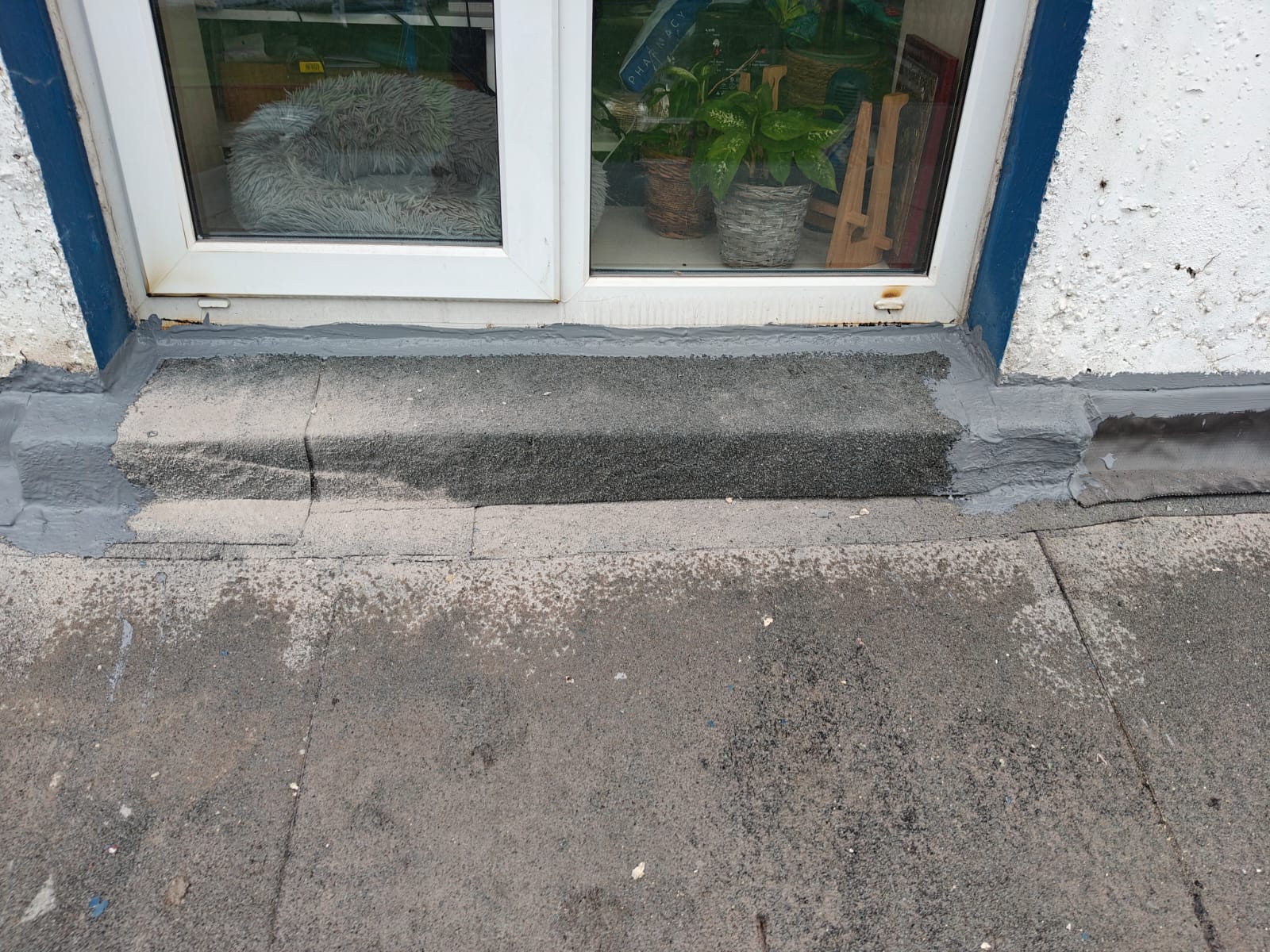

What it costs, how EPDM, GRP and felt actually perform on Cork extensions, and how to tell the deck has gone
Drive around Douglas, Bishopstown, Wilton, Ballincollig or Glanmire and the same thing repeats on hundreds of houses: a rear kitchen or utility extension added between the late 1970s and the mid-2000s, finished in three-layer felt on an 18 mm ply deck. Those felt roofs were specified for a 15-20 year life. The maths on a 1998 extension is now obvious.
The symptoms are consistent. Blisters and ripples across the surface after a hot summer. A dark patch spreading across the plasterboard above the sink. Grit from the mineral-felt cap sheet washing into the gutter. On south-facing extensions catching sun off the back garden all day, UV usually finishes the top sheet off five years earlier than the north-facing equivalent on the same estate.
If that is what you are looking at, the honest question is not which system to buy. It is whether the roof needs replacing at all yet, or whether a repair will get another five years from it. That call depends on the deck, and the deck is only visible once someone goes up and lifts a corner.
The following are indicative installed rates for 2026. VAT at 13.5% applies on top of all figures.
Indicative 2026 price range in euro per m², VAT (13.5%) not included
| System | Installed rate | Expected lifespan |
|---|---|---|
| EPDM rubber membrane | €90-€140 per m² | 25-35 years |
| GRP fibreglass | €90-€140 per m² | 25-30 years |
| Traditional felt | Not recommended for new work | 15-20 years |
| Deck replacement (where required) | +€30-€50 per m² | - |
What moves the final number is what we find once the old covering comes off: the state of the ply or OSB, the condition of the upstand against the house wall, whether the existing outlet is adequate, and whether the fall is actually falling the right way. We go up, lift a corner, and give a fixed-price written quote. That figure is the figure paid, with no revisions once the job starts, unless you ask us to do something extra.
For a rough ballpark before we visit, our roofing cost calculator gives a reasonable first number.
EPDM is a single sheet of synthetic rubber bonded to the deck with contact adhesive. On most Cork extensions it goes down as one piece with no seams, which matters because seams are where flat roofs fail. The membrane handles UV, the thermal movement between a cold February night and a warm May afternoon, and the sideways rain that comes in off the harbour without cracking or lifting.
Where it is the right choice: rear extensions, garage roofs, bay window tops and dormer cheeks. Anywhere nobody is walking on it regularly. On a south-facing Douglas or Bishopstown extension catching sun all day, EPDM is what we would put on our own house.
Where it is weaker: it is a soft membrane. If there is a terrace, a maintenance walkway or a plan to add solar later, GRP or EPDM with a walkway board makes more sense.
GRP is glass fibre matting saturated with polyester resin and cured into a single rigid shell. It gives a hard, seamless surface that takes foot traffic without complaint and handles rooflight kerbs and complex upstands cleanly.
Where it is the right choice: balconies, dormers you step out onto, extensions with heavy rooflights, and anywhere the edge detail is complex. Also where the owner wants a hard surface they can inspect and brush off easily.
Where it is weaker: GRP is less forgiving of seasonal movement than EPDM. On a long, unheated garage with a timber deck that moves, hairline cracks can appear at stress points over time. That is why the system is matched to the structure rather than applied to everything.
Three-layer torch-on felt had a long run as the default flat roof covering in Ireland, and it is what sits on most of the extensions we are now replacing. We no longer specify it for new work: 15-20 years of service against 25-35 for EPDM, UV degradation on south-facing Cork roofs faster than manufacturer figures suggest, and seam failure that EPDM simply does not have. We will carry out a felt repair where that is the right answer on a roof with several years left in it. We will not quote felt as a replacement system. More detail on systems and how they perform in Cork sits on our residential roofing page.
Often, yes. The repair-or-replace decision on a flat roof is more straightforward than on a pitched roof because the evidence is visible once someone goes up and looks properly.
A repair is usually the right answer when:
A replacement is usually the right answer when:
We go up, we look, we lift a corner where we need to, and we tell you which it is. We recommend a repair on a roof we could have sold a replacement for. It is the whole point of giving a written breakdown rather than a number at the door. See the flat roof refelting cost guide for more on what repair work typically involves and costs.
For a standard rear extension, a straightforward EPDM or GRP job runs 2-4 days on site in dry weather. The sequence is as follows.
Weather in Cork decides the start date. We do not strip a roof into a forecast we do not like.
Cork gets roughly 1,200 mm of rain a year, spread across 150+ wet days. That is a lot of water needing to reach one outlet on a 15 m² extension, often through a gutter that was sized for the original house and never upgraded when the extension went on.
Two things follow from that for flat roof design here. First, falls and outlet sizing matter more than they do in a drier climate. A roof that ponds, holding standing water for more than 48 hours after rain stops, will fail at the ponding spot first regardless of what membrane is on it. Falls are checked before quoting and corrected where they are wrong. Second, south-facing exposure in suburbs like Douglas, Rochestown and Grange is harder on membranes than most homeowners realise. A felt roof catching full southerly sun from a back garden with no overhang will fail years before the same roof on a north-facing elevation. EPDM handles it. GRP handles it. Felt does not, which is the practical reason it is no longer recommended for new work here.
Every full flat roof replacement we carry out comes with a 10-year written workmanship guarantee and the Lifetime Leak Guarantee. Both are automatic, both are handed over in writing before contracts are signed, and neither requires you to register anything. Repair work, where no replacement is carried out, carries a minimum 3-year workmanship guarantee, up to 10 years on major repairs.
Our crews are directly employed. We do not subcontract. The people on your roof are our people. You can read more about how we work on the reviews page and the case studies page.
“For our Sunday's Well home I needed a last-minute replacement of leaking roof at the rear of a three-storey house. Recommended Roofing provided a prompt, fair estimate and — despite the wet weather — had a scaffold tower in place and the job finished in one day. The installers (David and one colleague) were efficient, courteous, and helpful throughout, and they left the site tidy, removing all waste. Very pleased with the quick response, the team, and the quality of the work. Highly recommended.”Andy Byrne, Sunday's Well, Cork, ★★★★★ on Google
If you are outside Cork, the same service, the same guarantees and the same pricing structure apply across all four cities we cover.
To get a straight answer on whether your Cork flat roof needs replacing and what it should cost, request a free written quote or call us on 021 2040925. We go up, we look properly, and the price quoted is the price paid.
EPDM rubber and GRP fibreglass both run €90-€140 per m² installed (indicative 2026 figures, VAT at 13.5% on top). Deck replacement, where the existing ply or OSB has gone soft, adds roughly €30-€50 per m². The exact figure depends on what is found once the old covering comes off, which is why we give a written fixed-price quote after going up to inspect.
On a standard south-facing rear extension that nobody walks on, EPDM is generally the better choice: it handles UV and thermal movement well and goes down without seams. GRP suits extensions with heavy rooflights, complex upstand details, or where foot traffic is expected. We match the system to the structure rather than defaulting to one for everything.
Often yes. A repair is the right answer when the deck is still solid and the failure is localised to one upstand, vent or blister. A replacement is the right answer when the deck has gone soft in more than one area, there are multiple leak points, or the covering is at or past its design life. We come out, go up, and tell you honestly which applies.
A standard 12-20 m² rear extension is 2-4 days on site in dry weather. Add a day if the deck needs full replacement and another if there are complex rooflight or upstand details.
Every full flat roof replacement carries a 10-year written workmanship guarantee plus the Lifetime Leak Guarantee. Both are automatic and handed over in writing before contracts are signed. Repair work (where no replacement is carried out) carries a minimum 3-year guarantee, up to 10 years on major repairs.
Felt has a design life of 15-20 years against 25-35 years for EPDM. UV degradation on south-facing Cork roofs tends to be faster than manufacturer figures suggest, and the seams between rolls are weak points that a single-piece EPDM membrane does not have. We still repair felt roofs where that is the honest answer on a roof with useful life remaining.
We do not recommend it. Overlaying hides the condition of the deck, adds dead load, and compromises upstand heights at the house wall. The Lifetime Leak Guarantee does not apply to overlay work for exactly that reason.
Like-for-like replacement in the same materials normally does not require planning permission. Changing the roof profile, raising the parapet, or adding rooflights where none existed may. Protected structures and Architectural Conservation Area properties almost always require consent. We flag it when we see it.
We stop and tell you before going further. The cost of deck replacement, roughly €30-€50 per m², is agreed in writing before we continue. Nothing is added to the bill without your sign-off.
Most flat roof replacement work on single-storey extensions does not require scaffolding. Where the building is very high or on a busy street with heavy pedestrian traffic, scaffolding is priced in as a separate line on the quote, never buried in the job total. You are free to source it yourself if you can get a better rate.
Yes. We carry €6.5 million public liability insurance, €13 million employer liability insurance, and are CIRI registered, Guaranteed Irish and members of the National Guild of Master Craftsmen. We encourage customers to verify all of these before appointing us.
Yes. A quote visit for work we could carry out is free and comes with no obligation. We go up, inspect the deck and the covering, and give you a written breakdown. You can request one at /contact/ or by calling 021 2040925.
Nearby areas we cover
Roof Repairs in Cork, Ireland. Free survey, written fixed-price quote, 10-year guarantee.